
What Is a Safety Shower and Does Your Workplace Need One? A Guide for Australian Facility Managers
If your facility handles hazardous chemicals, corrosive materials, or any substance that poses a risk to skin or eyes, there is a good chance you are legally required to have emergency safety shower and eyewash equipment installed and maintained on site. For many facility managers, this is an area where compliance obligations are understood in principle but the specifics — what equipment is required, where it must be located, how it must be maintained, and who is responsible — are less clear.
This guide covers the key requirements under Australian Standard AS 4775, the different types of safety shower and eyewash equipment available, and what facility managers need to consider when specifying, installing, and maintaining compliant emergency equipment.
What Is a Safety Shower?
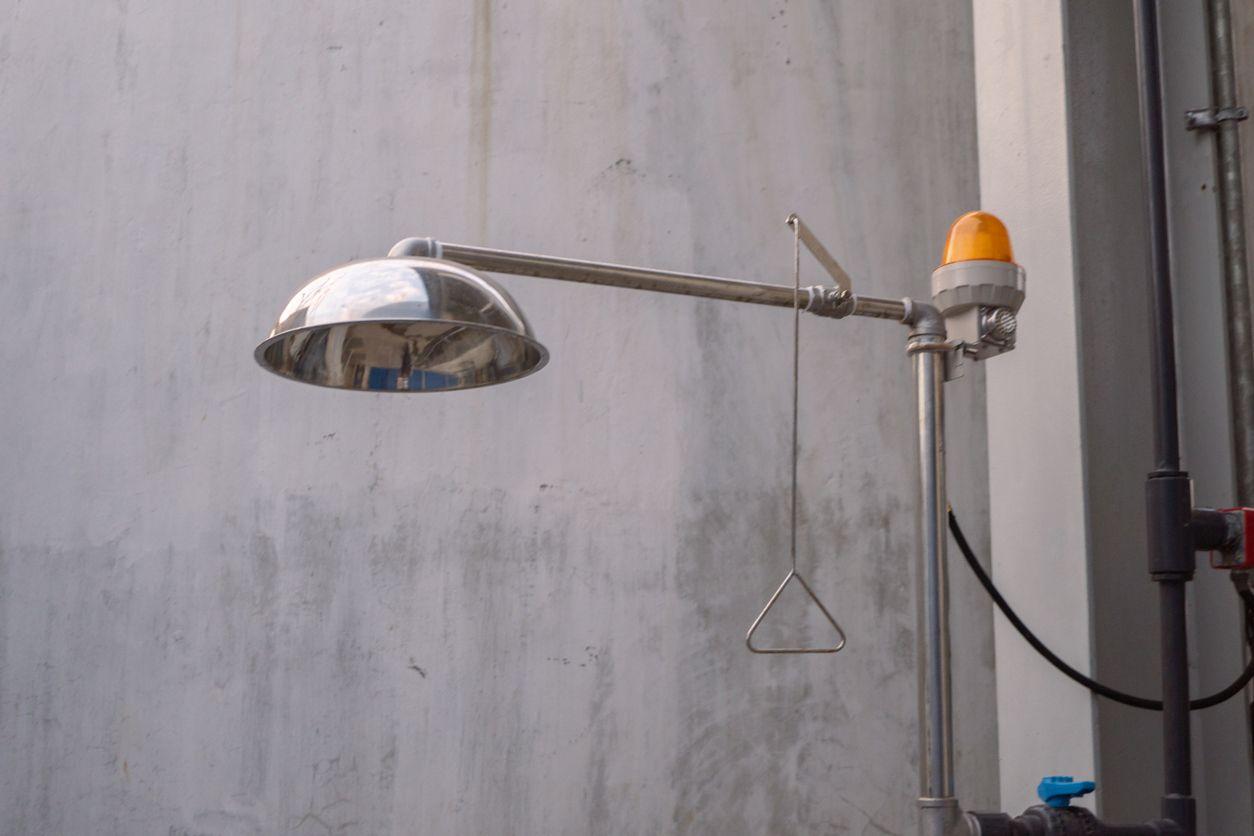
A safety shower (also called a drench shower or emergency shower) is a fixed plumbing installation designed to deliver a large volume of water over the full body of a person who has been exposed to a hazardous chemical or substance. The immediate and prolonged flushing of contaminated skin or clothing is the primary first aid response to most chemical exposure incidents, and a functioning safety shower within reach of the hazard is often the difference between a minor incident and a serious injury.
Safety showers are distinct from standard bathroom or amenity showers in several critical ways. They are designed to activate immediately — typically with a single pull of a stay-open ball valve — and to deliver a minimum flow of 75.7 litres per minute across a spray pattern at least 50.8 centimetres in diameter. They must be capable of operation by a person who may be injured, disoriented, or have limited use of their hands. And they must be available at all times, not locked away or obstructed.
Eyewash units serve a related but distinct function: delivering a controlled flow of water to flush both eyes simultaneously after chemical splash or contamination. They are often installed alongside safety showers as part of a combination unit, or separately where eye exposure is the primary risk.
The Australian Standard: AS 4775
The primary compliance framework for emergency eyewash and shower equipment in Australia is AS 4775 — Emergency Eyewash and Shower Equipment. This standard specifies performance requirements, installation requirements, and maintenance obligations for safety showers and eyewash units used in workplaces where hazardous substances are handled.
AS 4775 is not a standalone obligation — it operates within the broader framework of the Work Health and Safety Act (WHS Act) and relevant model WHS Regulations, which require duty holders to eliminate or minimise risks to health and safety so far as is reasonably practicable. Where hazardous chemicals are present, providing appropriate emergency equipment is part of meeting that duty. Failure to comply can result in improvement notices, prohibition notices, or prosecution by the relevant state or territory WHS regulator.
Key performance requirements under AS 4775 include:
- Flow rate: Safety showers must deliver a minimum of 75.7 litres per minute. Eyewash units must deliver a minimum of 11.4 litres per minute to both eyes simultaneously.
- Water temperature: Water delivered must be within the tepid water range of 16°C to 38°C. Water that is too hot or too cold can cause additional injury or discourage the user from maintaining flushing for the required duration.
- Flushing duration: The standard recommends a minimum flushing duration of 15 minutes for most chemical exposures. Equipment must be capable of delivering the required flow for this duration.
- Activation: Safety showers must be activatable in one second or less, and remain on without the user holding the activating device. Eyewash units must be capable of simultaneous flushing of both eyes.
- Location: Equipment must be located within 10 seconds of travel from the hazard — generally interpreted as no more than 10 to 16 metres, on the same level, with an unobstructed path.
What Types of Equipment Are Available?
Combination safety shower and eyewash units provide both a drench shower and an eyewash station from a single installation. They are the preferred specification in most laboratory, chemical handling, and industrial environments where both full-body and eye exposure are possible. A single plumbing connection supplies both functions, simplifying installation.
Standalone drench showers provide overhead body decontamination only. They are suited to facilities where a separate eyewash station is already installed nearby, or where only full-body exposure is a realistic hazard. Available in wall mount, ceiling mount, and floor mount pedestal configurations to suit different facility layouts.
Standalone eyewash and face wash units provide localised eye and face flushing only. They are appropriate where the primary risk is chemical splash to the face or eyes — common in laboratory environments with small-volume chemical handling — and where a separate drench shower is available within the required distance.
Foot pedal activation is available on some combination and eyewash units, allowing hands-free operation when hand or arm contamination makes manual activation difficult. This is strongly recommended in environments where hand exposure is a realistic scenario.
The Gentec Ecosafe range at PlumbingSales.com.au covers all of these configurations — combination shower and eyewash (wall and floor mount), standalone drench showers (wall, ceiling, and floor mount), and standalone eyewash units (wall and floor mount) — all in 304 stainless steel. Browse the full Gentec safety showers range for specifications and pricing.
Does Your Workplace Need a Safety Shower?
The short answer: if your facility handles hazardous chemicals or substances that could cause injury to skin or eyes, AS 4775 and your WHS obligations almost certainly require you to have compliant emergency equipment installed.
Common facility types where safety showers are required include:
- School and university science laboratories — one of the most common safety shower environments in Australia, where students and staff regularly handle corrosive or irritant chemicals
- Industrial and manufacturing facilities — where chemical processing, surface treatment, battery charging, or similar processes create exposure risk
- Chemical storage and handling areas — including warehouses, stockrooms, and chemical dosing stations
- Healthcare and pathology laboratories — where biological and chemical agents are handled
- Agricultural facilities — where pesticides, fertilisers, and other hazardous chemicals are stored or mixed
- Commercial kitchens and food processing — where cleaning chemicals and sanitisers pose a contact risk
If you are unsure whether your facility requires a safety shower installation, the starting point is a chemical risk assessment reviewed against your obligations under the WHS Act and the guidance in AS 4775. Your state or territory WHS regulator can also provide guidance on compliance obligations specific to your industry and jurisdiction.
Key Installation Considerations
Getting the specification right matters as much as the decision to install. The most common compliance failures identified in WHS inspections are not the absence of equipment, but equipment that is incorrectly located, inadequately supplied with water, or not maintained.
Location. AS 4775 requires safety showers to be within 10 seconds of travel from the hazard — unobstructed, on the same level, and clearly signposted. Every second of travel time matters in a chemical exposure incident, and equipment that requires a person to navigate stairs, open doors, or travel through other rooms does not meet the standard.
Water supply and temperature. The tepid water requirement (16–38°C) is often the most technically challenging aspect of compliance. In facilities where mains cold water temperature drops below 16°C in winter, or where hot water in the supply line may elevate temperatures above 38°C, a thermostatic mixing valve on the supply line is required to regulate delivery temperature. A licensed plumber should assess the supply conditions and specify the correct valve. Browse our valves range for thermostatic mixing valves and related products.
Signage. AS 4775 requires safety shower and eyewash locations to be clearly marked with appropriate safety signage. Gentec Ecosafe units include signs with every unit, but ensure signage is also visible from the hazard area and directional signage guides personnel to the equipment from distance.
Flow testing. Adequate water pressure and flow rate must be confirmed at installation and verified by a licensed plumber against the AS 4775 minimums before the equipment is commissioned.
Maintaining Safety Shower Equipment
Weekly activation testing is required for all safety showers and eyewash units. Each unit should be activated for a sufficient duration to verify it is operational, the flow is unobstructed, and the water delivery is functioning correctly. This also flushes any stagnant water from the supply line — important for maintaining water quality in infrequently used units. Test results should be recorded and retained.
Annual inspection by a qualified person is recommended to verify that flow rates, spray patterns, activation mechanisms, and water temperature delivery continue to meet AS 4775 requirements.
Obstruction checks should be included in routine facility inspections. Equipment that is blocked by stored materials, locked enclosures, or temporary structures is non-compliant — regardless of whether it was correctly installed.
Gentec Ecosafe units include test tags with every unit to support record-keeping from the point of installation.
Specifying and Sourcing Safety Shower Equipment
When specifying safety shower equipment, the key factors are configuration (combination, drench, or eyewash only), mounting type (wall, ceiling, or floor), activation method (manual or foot pedal), and material. AS 4775 does not mandate stainless steel, but 304 stainless steel is the preferred material for most commercial and industrial applications due to its corrosion resistance, durability, and ease of cleaning in demanding environments.
PlumbingSales.com.au stocks the complete Gentec Ecosafe range — seven products covering every configuration required for AS 4775 compliant installation, all in 304 stainless steel and all with free shipping to most areas Australia-wide. Browse the full Gentec safety showers range or explore the broader Gentec commercial tapware range for anti-ligature and anti-vandal tapware suited to the same institutional environments.
For installation, always engage a licensed plumber experienced in commercial and institutional plumbing. Your plumber will assess the water supply conditions, specify any additional components required (including thermostatic mixing valves), confirm flow rates at installation, and ensure the installation meets AS 4775 and your applicable WHS obligations.
Need help identifying the right safety shower configuration for your facility? Call our team on 1800 341 972 or email [email protected]. We're happy to assist facilities managers, WHS coordinators, and licensed plumbers with product selection and specifications.